The Open Group OGEA-101시험유효자료 - OGEA-101최신업데이트공부자료
Wiki Article
BONUS!!! PassTIP OGEA-101 시험 문제집 전체 버전을 무료로 다운로드하세요: https://drive.google.com/open?id=1MQV2LJyAow1AFZIqOiqMgP6l0l80w3_1
우리는 고객이 첫 번째 시도에서The Open Group OGEA-101 자격증시험을 합격할수있다는 것을 약속드립니다. The Open Group OGEA-101 시험을 합격하여 자격증을 손에 넣는다면 취직 혹은 연봉인상 혹은 승진이나 이직에 확실한 가산점이 될것입니다. The Open Group OGEA-101시험 어려운 시험이지만 저희The Open Group OGEA-101덤프로 조금이나마 쉽게 따봅시다.
The Open Group OGEA-101 시험요강:
| 주제 | 소개 |
|---|---|
| 주제 1 |
|
| 주제 2 |
|
| 주제 3 |
|
| 주제 4 |
|
| 주제 5 |
|
>> The Open Group OGEA-101시험유효자료 <<
OGEA-101최신 업데이트 공부자료 & OGEA-101최고품질 인증시험공부자료
The Open Group OGEA-101 시험을 한번에 합격할수 없을가봐 두려워 하고 계시나요? 이 글을 보고 계신 분이라면 링크를 클릭하여 저희 사이트를 방문해주세요. 저희 사이트에는The Open Group OGEA-101 시험의 가장 최신 기출문제와 예상문제를 포함하고 있는 The Open Group OGEA-101덤프자료를 제공해드립니다.덤프에 있는 문제와 답을 완벽하게 기억하시면 가장 빠른 시일내에 가장 적은 투자로 자격증 취득이 가능합니다.
최신 Enterprise Architecture OGEA-101 무료샘플문제 (Q97-Q102):
질문 # 97
Consider the following descriptions of deliverables consumed and produced across the TOGAF ADM cycle.
* General rules and guidelines, intended to be enduring and seldom amended, that inform and support the way in which an organization sets about fulfilling its mission
* A set of quantitative statements that outline what an implementation project must do in order to comply with the architecture.
* A document that is sent from the sponsoring organization to the architecture organization to trigger the start of an architecture development cycle
* The scope and approach that will be used to complete an architecture development cycle Complete the sentence. Deliverable 3 is the, deliverable 4 is a deliverable from
- A. Stakeholder Map, Phase G
- B. Architecture Requirements Specification, Preliminary Phase
- C. Request for Architecture Work, Phase A
- D. Architecture Definition Document, Phase H
정답:C
설명:
In TOGAF's ADM, the Request for Architecture Work is the deliverable issued by the sponsoring organization (or stakeholder) to formally request that the architecture team perform a full architecture development cycle. That corresponds to your "deliverable 3." Then, the architecture team responds by producing a Statement of Architecture Work (in Phase A), which defines the scope, constraints, approach, and high#level tasks for the architecture development. That is your "deliverable 4" (the scope and approach).
Thus deliverable 3 is the Request for Architecture Work, and deliverable 4 is generated in Phase A. The Request triggers the cycle; the Statement of Architecture Work (in Phase A) lays down how the architecture work will proceed, including scoping and approach.
질문 # 98
Consider the following ADM phases objectives.
Objective
1-Determine whether an incremental approach is required, and if so identify Transition Architectures that will deliver continuous business value
2-Generate the initial complete version of the Architecture Roadmap, based upon the gap analysis and candidate Architecture Roadmap components from Phases B, C, and D
3-Finalize the Architecture Roadmap and the supporting Implementation and Migration Plan
4-Ensure that the business value and cost of work packages and Transition Architectures is understood by key stakeholders Which phase does each objective match?
- A. 1G-2E-3F-4F
- B. 1F-2E-3F-4G
- C. 1E-2F-3E-4F
- D. 1E-2E-3F-4F
정답:A
설명:
According to the TOGAF standard, the objectives of each ADM phase are as follows1:
*Phase E: Opportunities and Solutions
oDetermine whether an incremental approach is required, and if so identify Transition Architectures that will deliver continuous business value oIdentify and group major work packages within the Architecture Roadmap oIdentify and group major implementation projects to realize the Architecture Roadmap oIdentify dependencies between increments and projects oEstimate cost, benefit, and risk at a high level for each increment and project oConduct initial prioritization and sequencing of the Architecture Roadmap and projects
*Phase F: Migration Planning
oGenerate the initial complete version of the Architecture Roadmap, based upon the gap analysis and candidate Architecture Roadmap components from Phases B, C, and D oConfirm the Transition Architectures with relevant stakeholders oCreate the Implementation and Migration Plan, including Transition Architectures, work packages, projects, and other activities oConfirm and agree the Architecture Roadmap and Implementation and Migration Plan with relevant stakeholders
*Phase G: Implementation Governance
oFinalize the Architecture Roadmap and the supporting Implementation and Migration Plan oEnsure conformance with the Target Architecture by implementation projects oPerform appropriate Architecture Governance functions for the solution and any implementation-driven architecture Change Requests oEnsure that the architecture lifecycle is maintained oEnsure that the Architecture Governance Framework is executed
*Phase H: Architecture Change Management
oEnsure that the business value and cost of work packages and Transition Architectures is understood by key stakeholders oManage risks and issues related to the Architecture Roadmap and Implementation and Migration Plan oMonitor the implementation projects and Transition Architectures oManage changes to the architecture baseline oManage changes to the Architecture Capability Therefore, the correct matching of the objectives and the phases is:
*1G: Determine whether an incremental approach is required, and if so identify Transition Architectures that will deliver continuous business value
*2E: Generate the initial complete version of the Architecture Roadmap, based upon the gap analysis and candidate Architecture Roadmap components from Phases B, C, and D
*3F: Finalize the Architecture Roadmap and the supporting Implementation and Migration Plan
*4F: Ensure that the business value and cost of work packages and Transition Architectures is understood by key stakeholders
질문 # 99
Complete the sentence The Architecture Landscape is divided into levels known as__________________________.
- A. Transitional Complete and incremental Architectures
- B. Baseline. Transition and To Be Architectures
- C. Segment Strategic and Capability Architectures
- D. Gaps Plateaus, and Target Architectures
정답:C
설명:
The Architecture Landscape is divided into levels known as Segment Strategic and Capability Architectures.
These levels correspond to different scopes and purposes of architectures within an enterprise. Segment Architectures are architectures that address specific business units, functions, or processes within an enterprise. Strategic Architectures are architectures that provide a high-level view of the enterprise's vision, goals, and direction. Capability Architectures are architectures that address specific business capabilities or services that span multiple segments or domains. Reference: The TOGAF Standard | The Open Group Website, Section 2.4 Architecture Repository.
질문 # 100
According to the TOGAF Standard, what are the two levels of risk that should be monitored?
- A. Initial and Residual level
- B. Technical and Financial level
- C. Mitigated and Revised level
- D. Operational and Strategic level
정답:A
설명:
"There are two levels of risk that should be considered namely: Initial Level of Risk [and] Residual Level of Risk." archive.opengroup.org Reference: The Open Group Conference Proceedings, From Architecture to Execution with TOGAF 9 (R.
Weisman) - Risk Management section.
질문 # 101
Exhibit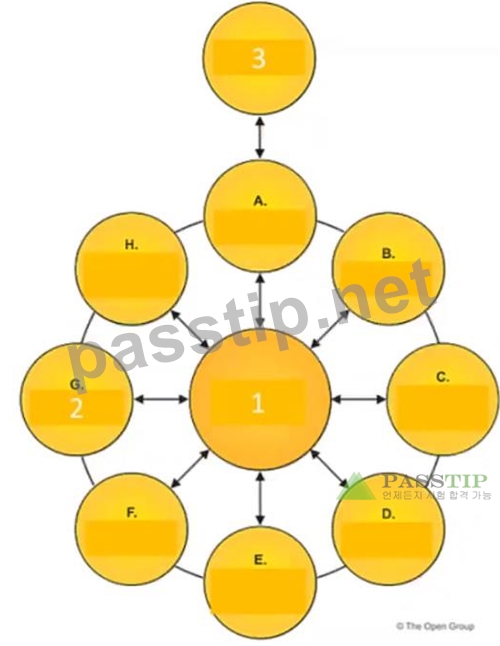
Consider the illustration showing an architecture development cycle Which description matches the phase of the ADM labeled as item 1?
- A. Establishes procedures for managing change to the new architecture
- B. Operates the process of managing architecture requirements
- C. Provides architectural oversight for the implementation
- D. Conducts implementation planning for the architecture defined in previous phases
정답:B
설명:
* The illustration shows an architecture development cycle based on the TOGAF ADM (Architecture Development Method), which is a method for developing and managing an enterprise architecture1.
* The ADM consists of nine phases, each with a specific purpose and output. The phases are1:
oPreliminary Phase: To prepare and initiate the architecture development cycle, including defining the architecture framework, principles, and governance.
oPhase A: Architecture Vision: To define the scope, vision, and stakeholders of the architecture initiative, and to obtain approval to proceed.
oPhase B: Business Architecture: To describe the baseline and target business architecture, and to identify the gaps between them.
oPhase C: Information Systems Architectures: To describe the baseline and target data and application architectures, and to identify the gaps between them.
oPhase D: Technology Architecture: To describe the baseline and target technology architecture, and to identify the gaps between them.
oPhase E: Opportunities and Solutions: To identify and evaluate the opportunities and solutions for implementing the target architecture, and to define the work packages and transition architectures.
oPhase F: Migration Planning: To finalize the implementation and migration plan, and to ensure alignment with the enterprise portfolio and project management.
oPhase G: Implementation Governance: To provide architecture oversight and guidance for the implementation projects, and to manage any architecture change requests.
oPhase H: Architecture Change Management: To monitor the changes in the business and technology environment, and to assess the impact and performance of the architecture.
* In addition to these phases, there is a central process called Requirements Management, which is labeled as item 1 in the illustration. This process operates throughout the ADM cycle, and its purpose is to manage the architecture requirements throughout the architecture development, ensuring that they are aligned with the business requirements and the stakeholder concerns2.
* Therefore, the description that matches the phase of the ADM labeled as item 1 is C. Operates the process of managing architecture requirements.
Reference:
* 1: The TOGAF Standard, Version 9.2, Chapter 5: Architecture Development Method (ADM)
* 2: The TOGAF Standard, Version 9.2, Chapter 17: Requirements Management
질문 # 102
......
이 산업에는 아주 많은 비슷한 회사들이 있습니다, 그러나 PassTIP는 다른 회사들이 이룩하지 못한 독특한 이점을 가지고 있습니다. Pss4Test The Open Group OGEA-101덤프를 결제하면 바로 사이트에서The Open Group OGEA-101덤프를 다운받을수 있고 구매한The Open Group OGEA-101시험이 종료되고 다른 코드로 변경되면 변경된 코드로 된 덤프가 출시되면 비용추가없이 새로운 덤프를 제공해드립니다.
OGEA-101최신 업데이트 공부자료: https://www.passtip.net/OGEA-101-pass-exam.html
- 퍼펙트한 OGEA-101시험유효자료 최신버전 덤프데모 문제 ???? ▷ OGEA-101 ◁를 무료로 다운로드하려면➽ www.exampassdump.com ????웹사이트를 입력하세요OGEA-101덤프내용
- OGEA-101인기자격증 시험덤프 최신자료 ???? OGEA-101시험대비 최신버전 문제 ???? OGEA-101인기자격증 시험덤프 최신자료 ⏺ 오픈 웹 사이트▶ www.itdumpskr.com ◀검색➤ OGEA-101 ⮘무료 다운로드OGEA-101덤프내용
- OGEA-101시험유효자료 최신 인기 인증시험자료 ✌ ➤ www.dumptop.com ⮘에서 검색만 하면⏩ OGEA-101 ⏪를 무료로 다운로드할 수 있습니다OGEA-101인기자격증 시험덤프 최신자료
- OGEA-101인기자격증 시험덤프 최신자료 ???? OGEA-101시험대비 최신버전 문제 ???? OGEA-101완벽한 시험기출자료 ???? 시험 자료를 무료로 다운로드하려면➤ www.itdumpskr.com ⮘을 통해( OGEA-101 )를 검색하십시오OGEA-101시험대비 최신버전 문제
- OGEA-101시험유효자료 인기자격증 시험자료 ✅ 무료로 다운로드하려면▶ www.koreadumps.com ◀로 이동하여“ OGEA-101 ”를 검색하십시오OGEA-101최고품질 덤프문제
- OGEA-101최고기출문제 ???? OGEA-101퍼펙트 인증공부 ???? OGEA-101완벽한 덤프문제 ???? 검색만 하면⇛ www.itdumpskr.com ⇚에서( OGEA-101 )무료 다운로드OGEA-101합격보장 가능 덤프문제
- OGEA-101최고기출문제 ???? OGEA-101완벽한 공부문제 ???? OGEA-101덤프문제모음 ???? [ kr.fast2test.com ]을(를) 열고【 OGEA-101 】를 입력하고 무료 다운로드를 받으십시오OGEA-101참고덤프
- OGEA-101시험유효자료 최신 인증시험 ???? 오픈 웹 사이트( www.itdumpskr.com )검색➤ OGEA-101 ⮘무료 다운로드OGEA-101인증덤프샘플 다운
- 높은 통과율 OGEA-101시험유효자료 공부문제 ???? ⏩ kr.fast2test.com ⏪은➠ OGEA-101 ????무료 다운로드를 받을 수 있는 최고의 사이트입니다OGEA-101시험대비 최신버전 문제
- OGEA-101덤프샘플 다운 ???? OGEA-101최신 업데이트 덤프문제 ???? OGEA-101덤프내용 ???? 지금{ www.itdumpskr.com }을(를) 열고 무료 다운로드를 위해“ OGEA-101 ”를 검색하십시오OGEA-101최고기출문제
- OGEA-101합격보장 가능 덤프문제 ???? OGEA-101완벽한 공부문제 ???? OGEA-101참고덤프 ???? ➤ www.exampassdump.com ⮘의 무료 다운로드▷ OGEA-101 ◁페이지가 지금 열립니다OGEA-101덤프내용
- haseebzikr661999.yourkwikimage.com, www.stes.tyc.edu.tw, tayaqxbn878167.techionblog.com, classrooms.deaduniversity.com, socialwebconsult.com, programi.healthandmore.rs, pennyacry129874.activoblog.com, ihannaqclh974973.blog4youth.com, tutorlms-test-14-05-24.diligite.com, totalbookmarking.com, Disposable vapes
그 외, PassTIP OGEA-101 시험 문제집 일부가 지금은 무료입니다: https://drive.google.com/open?id=1MQV2LJyAow1AFZIqOiqMgP6l0l80w3_1
Report this wiki page